Why Digital Transformation Is Urgent for Saudi SMEs Right Now
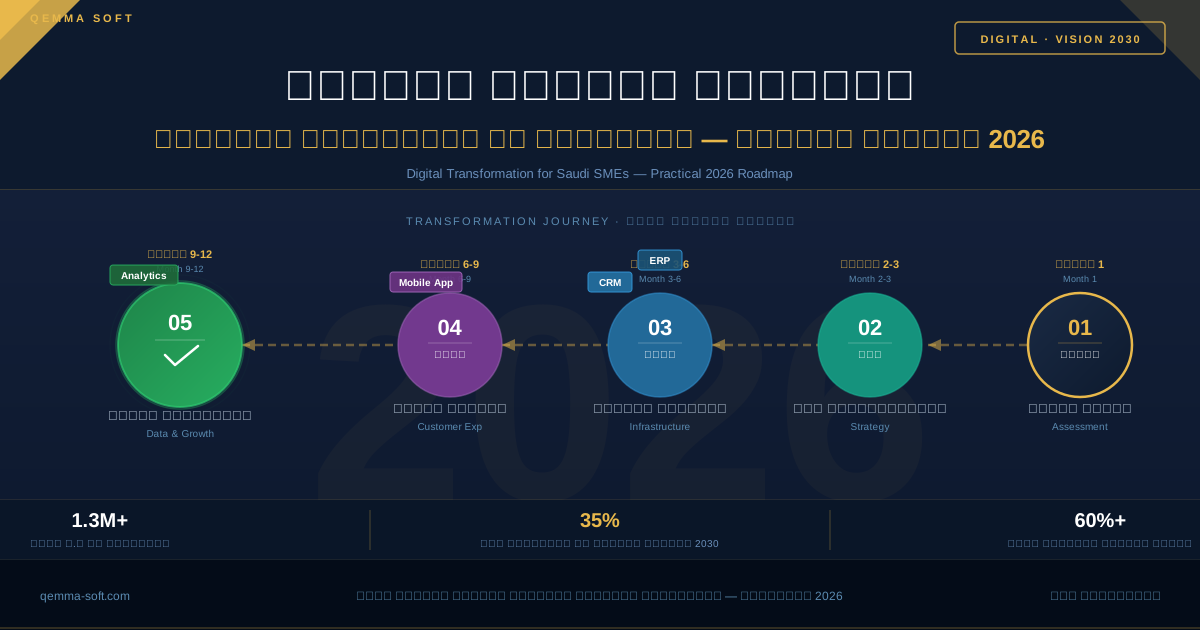
Saudi Arabia's Vision 2030 has set an ambitious target: SMEs should contribute 35% of GDP by 2030, up from around 20% today. Achieving that requires one thing above all else — digitalization. The government is investing billions in digital infrastructure, and consumer behavior has already shifted: over 60% of Saudi consumers now research and purchase online before ever setting foot in a physical store.
The problem? Most Saudi SMEs are stuck. They know they need to digitalize, but the journey feels overwhelming. Where do you start? What technologies actually matter? How much does it cost? What order should things happen in?
This guide answers all of those questions with a concrete, practical, stage-by-stage roadmap.
What Digital Transformation Actually Means (It's Not Just a Website)
A common misconception: digital transformation = building a website or launching an app. It's not. A website with no backend systems, no data integration, and no change in how you serve customers is just a digital brochure.
True digital transformation means changing how your business operates, how it serves customers, and how it makes decisions — using technology as the enabler across all three dimensions:
- Operations: Automating repetitive tasks, connecting systems, reducing manual work
- Customer experience: Making it faster, easier, and more satisfying for customers to do business with you — online and offline
- Decision-making: Using real data (not gut feel) to understand what's working, what's not, and where to invest next
With that definition in mind, here is the 5-stage roadmap.
Stage 1: Digital Assessment — Know Where You Stand (Month 1)
You cannot plan a journey without knowing your starting point. Before investing a single riyal in technology, conduct an honest assessment of your current digital maturity across four areas:
- Customer touchpoints: How do customers find you, communicate with you, and buy from you? What fraction of this is digital vs. manual?
- Internal operations: Which processes are still manual (invoicing, inventory, HR, accounting)? Where are the bottlenecks?
- Data: Do you have a CRM? Do you track sales by product, by channel, by customer segment? Do you know your customer acquisition cost?
- Technology stack: What software do you currently use? Is it integrated or does each system work in isolation?
The output of Stage 1 is a clear picture: your current state, your biggest pain points, and the gaps between where you are and where you need to be.
Stage 2: Strategy — Prioritize, Don't Boil the Ocean (Months 2–3)
After assessment, many SMEs make a critical mistake: they try to do everything at once. They launch a new website, implement an ERP, build a mobile app, and set up CRM — all simultaneously. The result is chaos, blown budgets, and failed projects.
The right approach: prioritize ruthlessly. Ask three questions:
- Which digital initiative will have the fastest, most visible impact on revenue or costs?
- Which initiative unblocks the most other initiatives? (Example: fixing your data infrastructure before investing in analytics)
- What can we realistically execute in the next 90 days with the team and budget we have?
A typical Saudi SME digital strategy for Year 1 looks like this:
- Q1: Professional website + Google Business Profile + WhatsApp Business automation
- Q2: CRM implementation + basic customer data collection
- Q3: E-commerce or online booking capability
- Q4: Analytics dashboard + first data-driven marketing campaign
This is not a one-size-fits-all template — your priorities depend on your sector (retail, services, F&B, healthcare, logistics) and your current gaps.
Stage 3: Core Infrastructure — Build the Foundation (Months 3–6)
Digital transformation runs on infrastructure. Before you can wow customers with a great digital experience, you need the systems behind the scenes to work. The three non-negotiables:
CRM (Customer Relationship Management)
Every customer interaction — phone call, WhatsApp message, website inquiry, purchase — should be recorded in one place. Without a CRM, you are flying blind. You don't know who your best customers are, why customers churn, or which marketing channels are actually working. Start simple: even a well-configured HubSpot free tier is transformative for most Saudi SMEs.
ERP or Accounting Software
Manual invoicing, Excel-based inventory, and disconnected financial records cost you more in errors and wasted time than a proper system ever would. In Saudi Arabia, your accounting software must also be ZATCA-compliant for e-invoicing (mandatory since 2021). Options: Odoo (flexible, Arabic-capable), Zoho Books, or a custom Laravel-based system for complex operations.
Cloud Infrastructure
Stop running critical business operations on local servers or personal laptops. Move to cloud — your data becomes accessible, backed up, and secure. AWS, Google Cloud, and Microsoft Azure all have presence in Saudi Arabia with local data residency options for sensitive data.
Stage 4: Digitize the Customer Experience (Months 6–9)
Now that your back-end is in order, it's time to transform how customers experience your brand digitally. This is the stage customers actually see and feel — and where you start winning in the market.
Professional, Fast Website
Not just aesthetically pleasing — technically excellent. Core Web Vitals score above 90, mobile-first, full Arabic RTL support, and built for SEO from day one. A slow website costs you customers: 53% of mobile users abandon a page that takes more than 3 seconds to load.
Mobile App or Progressive Web App (PWA)
If your customers interact with you regularly (orders, bookings, loyalty programs, support), a mobile app dramatically increases retention and lifetime value. For most SMEs, a PWA (a website that behaves like an app) is the right starting point — lower cost, no app store submission, instant updates.
WhatsApp Business Automation
Saudi Arabia has one of the highest WhatsApp usage rates in the world. Automating your WhatsApp channel — order confirmations, appointment reminders, support FAQs — can handle 60–70% of routine customer communications without adding headcount.
Digital Payment Integration
Accept all Saudi payment methods: Mada, STC Pay, Apple Pay, Tabby (BNPL), and Tamara (BNPL). Businesses that offer multiple payment options see 25–40% higher conversion rates than those with limited options.
Stage 5: Data-Driven Growth — Continuous Improvement (Months 9–12+)
The final stage is where the real competitive advantage lives — and it never ends. Digital transformation is not a project with a finish line; it's an ongoing capability.
At this stage, you have clean data flowing from your website, CRM, ERP, and customer channels. Now you use it:
- Analytics dashboards: Real-time visibility into sales, customer acquisition, operational costs, and marketing ROI
- A/B testing: Systematically test pricing, messaging, and product offerings to optimize conversion
- AI-powered personalization: Serve different customers different content, offers, and recommendations based on their behavior
- Predictive demand: Use historical sales data to optimize inventory, reduce waste, and avoid stockouts
The 5 Most Common Mistakes Saudi SMEs Make
- Starting with the tool, not the problem: Buying software before understanding the specific business problem it solves
- Underinvesting in change management: Technology is 30% of transformation — the other 70% is getting your team to actually use it
- Building instead of buying: Custom-coding a CRM when HubSpot or Zoho would do the job. Custom development is powerful, but only when you genuinely need capabilities that existing tools don't offer
- Ignoring data quality: Launching analytics tools on top of messy, incomplete data produces meaningless insights
- Treating it as a one-time project: Digital transformation requires ongoing investment, iteration, and leadership commitment
What Does It Actually Cost?
Realistic budgets for Saudi SMEs in 2026:
- Starter (SAR 15,000–40,000/year): Professional website, Google Workspace, WhatsApp Business API, basic CRM (HubSpot free), ZATCA-compliant accounting software
- Growth (SAR 40,000–120,000/year): All of the above + custom mobile app or PWA, e-commerce capability, advanced CRM, integrated analytics dashboard
- Advanced (SAR 120,000+/year): Full ERP, custom AI features, multi-channel automation, dedicated data engineering
The ROI case is strong: Saudi businesses that complete their digital transformation report an average of 20–35% reduction in operational costs and 15–30% increase in revenue within 18 months.
How Qemma Soft Helps Saudi SMEs Transform
At Qemma Soft, we work with Saudi SMEs at every stage of the digital transformation journey. We don't just build websites or apps — we help you diagnose the right starting point, build the right systems in the right order, and make sure your team can actually use what we build.
Our services cover the full stack: custom web development, mobile apps, e-commerce platforms, CRM implementation, ERP integration, ZATCA-compliant billing, and data analytics.
Related guides: Building an E-Commerce Store in Saudi Arabia | AI in Mobile Apps for Saudi Businesses | How to Choose the Right Software Partner
Get a free digital transformation assessment for your business →
Frequently Asked Questions
Is digital transformation only for large companies?
Absolutely not. In fact, SMEs often see faster and more dramatic ROI from digitalization than large enterprises, because they have less legacy infrastructure to untangle and can move faster. The tools available in 2026 — cloud CRMs, low-code platforms, API-first software — make enterprise-grade capabilities accessible to any business regardless of size.
Where should we start if we have a limited budget?
Start with the highest-pain point in your customer journey. If customers can't find you online — fix your website and Google Business Profile first. If you're drowning in manual invoicing — implement ZATCA-compliant accounting software. If customer follow-up is falling through the cracks — set up a basic CRM. One system done well beats five systems done poorly.
How long does digital transformation take?
The foundational stages (Stages 1–3) typically take 3–6 months for an SME with focused effort. Customer-facing improvements (Stage 4) take another 3–6 months. Stage 5 (data-driven continuous improvement) is ongoing — but you start seeing meaningful results within the first year.
Do we need a dedicated IT team?
Not necessarily. Most of the tools in Stages 1–3 are managed services with no on-premise infrastructure to maintain. What you do need is a designated internal champion — someone who owns the transformation project, manages vendor relationships, and ensures adoption. This can be a business owner, operations manager, or a part-time digital consultant.