Riyadh is no longer a regional story. In 2026, Saudi Arabia has become a global benchmark for what a government-backed startup ecosystem can achieve when policy, capital, and demographic tailwinds align simultaneously.
The Numbers That Changed the Narrative
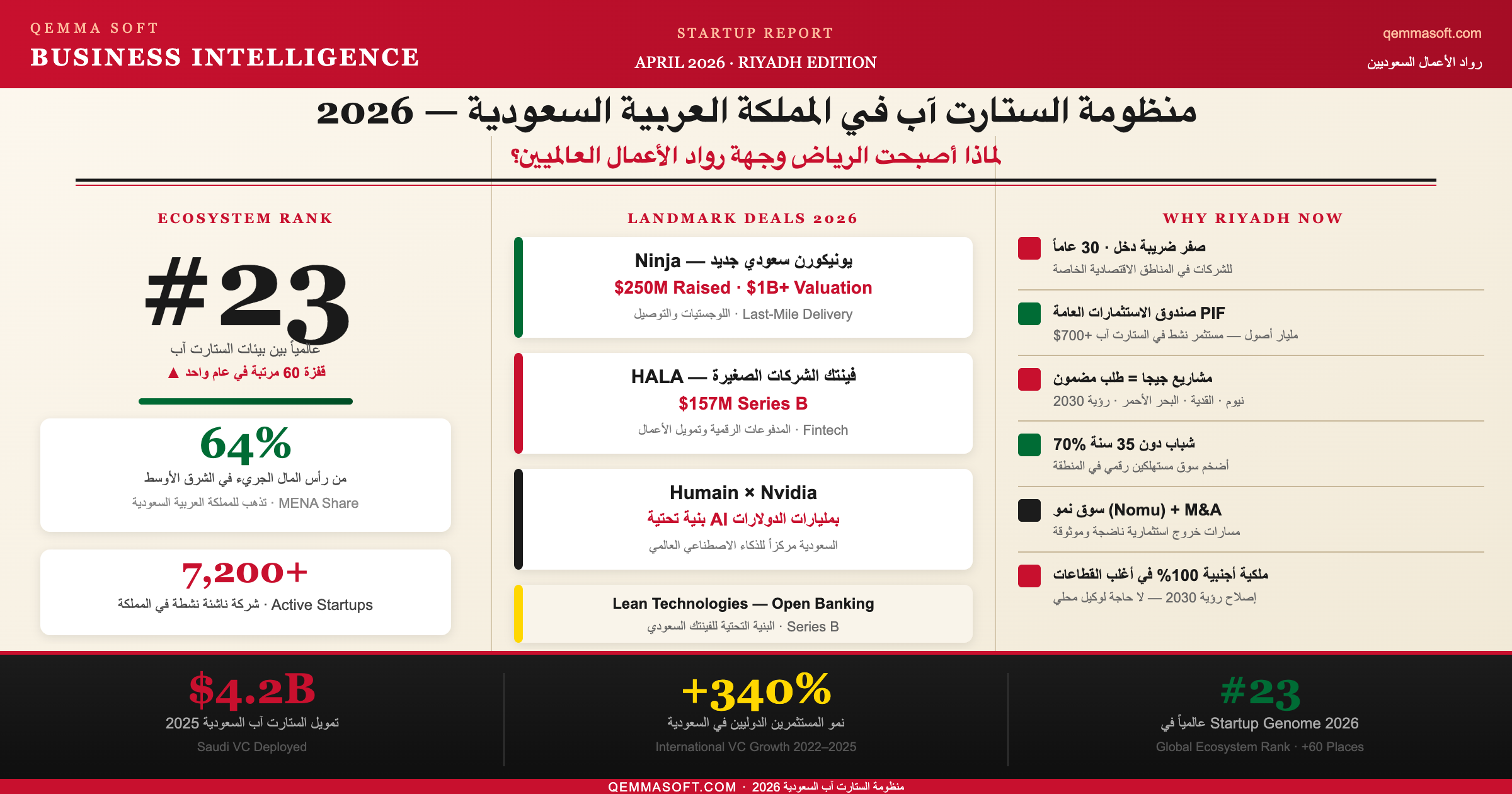
The Startup Genome 2026 Global Ecosystem Report delivered a seismic finding: Riyadh jumped 60 places in a single year to rank 23rd among the world's top startup ecosystems — ahead of cities like Berlin, Stockholm, and Seoul. Saudi Arabia now captures 64% of all venture capital deployed in the Middle East and North Africa, making it the uncontested regional hub.
The total venture capital deployed into Saudi startups in 2025 reached $4.2 billion — up from $1.1 billion in 2022 — a 280% growth in three years. International venture capital firms entering the Saudi market grew by 340% over the same period.
The Landmark Deals Defining 2026
The credibility of an ecosystem is measured by its exits and its unicorns. Saudi Arabia delivered both emphatically in 2025–2026:
-
Ninja — The logistics and delivery platform raised $250 million, crossing the unicorn threshold ($1 billion+ valuation). Ninja is now the fastest-growing last-mile delivery network in the Kingdom, processing millions of deliveries monthly across Riyadh, Jeddah, and the Eastern Province.
-
HALA — The fintech platform focused on SME payments and working capital closed a $157 million Series B. HALA processes billions of riyals in B2B transactions annually, proving that embedded finance for Saudi small businesses is a venture-scale opportunity.
-
Humain × Nvidia — PIF-backed Humain signed a landmark partnership with Nvidia to build sovereign AI infrastructure in Saudi Arabia, positioning the Kingdom as a global AI compute hub. This deal alone signals that Saudi Arabia is not merely a consumer of global technology — it intends to be a producer.
-
Lean Technologies — The open banking infrastructure layer continues expanding, enabling an entire generation of fintech startups to build on top of Saudi Arabia's banking system without direct bank integrations.
Why Riyadh? The Structural Advantages That Matter
This is not a marketing narrative. There are five structural advantages that make Saudi Arabia objectively compelling for founders in 2026:
1. Zero Corporate Income Tax for 30 Years The Special Economic Zones (SEZs) — particularly the NEOM Zone, the Aqaba-equivalent King Abdullah Economic City, and the Cloud Computing Zone — offer qualifying foreign companies a 30-year exemption from corporate income tax. For a startup that plans to reach profitability within 5–7 years, this is a material financial advantage that compounds over time.
2. The Public Investment Fund (PIF) — The World's Most Active Government Investor PIF manages over $700 billion in assets and has deployed capital into Saudi startups both directly (through Sanabil Investments, its venture arm) and indirectly through the Saudi Venture Capital Company (SVC), which co-invests alongside private VCs. SVC has committed to deploying $1.6 billion to develop the local VC ecosystem by 2030.
3. Giga-Projects as Guaranteed Demand NEOM, Qiddiya, the Red Sea Project, and ROSHN collectively represent over $1 trillion in planned construction and development spend. Every one of these projects creates demand for construction tech, logistics platforms, smart city software, workforce management tools, and consumer apps. Founders who position their startups as solutions providers to these projects have a captive, government-backed customer base from day one.
4. Demographics That Create Scale 70% of Saudi Arabia's 36 million population is under 35 years old — making it one of the youngest consumer markets in the world. This demographic is digitally native, mobile-first, and has high discretionary spending power due to historically low taxation. Sectors that benefit most: gaming, e-commerce, health tech, edtech, and entertainment.
5. A Maturing Exit Ecosystem The Saudi Exchange (Tadawul) launched a new parallel market (Nomu) specifically designed for growth-stage companies seeking to go public at a lower regulatory threshold. Combined with increased M&A activity from Saudi corporates acquiring startups, founders now have credible exit paths — not just the hope of an eventual acquisition by a global tech company.
Top Sectors for Saudi Startups in 2026
Not all sectors are equal. Based on government priorities, market gaps, and recent funding data, these five sectors represent the highest-opportunity areas for Saudi founders:
Fintech and Embedded Finance Saudi Arabia has one of the highest smartphone banking adoption rates in the world (89%), yet large segments of the SME sector remain underbanked for credit products. BNPL (Buy Now Pay Later) platforms like Tamara and Tabby have proven the consumer appetite. The next wave: SME credit scoring, payroll fintech, and cross-border B2B payments.
AI and Vertical Software General-purpose AI tools are commoditizing. The opportunity in Saudi Arabia is vertical AI — software trained on Arabic language, Islamic finance regulations, ZATCA e-invoicing requirements, and Saudi labor law. Founders who build AI products with deep Saudi market context cannot be easily displaced by a generic Western competitor.
Health Tech and Digital Health Vision 2030's healthcare privatisation initiative is creating a $65 billion opportunity. The government is actively seeking private sector partners to digitise medical records, build telemedicine infrastructure, and develop preventive healthcare platforms. Health tech startups in KSA have a regulatory tailwind that is rare globally.
EdTech and Skills Development Saudi Arabia's Human Capability Development Program (HCDP) has committed over $20 billion to education reform. The demand for Arabic-language professional skills platforms, coding bootcamps, and corporate training tools is structurally driven by Vision 2030's Saudisation employment targets.
Logistics and Last-Mile Delivery Ninja's unicorn milestone is just the beginning. The growth of Saudi e-commerce (projected to reach $30 billion by 2027) creates sustained demand for cold-chain logistics, same-day delivery infrastructure, returns management, and cross-border commerce solutions.
What Founders Need to Know Before Relocating or Launching
Legal Structure Options:
- Limited Liability Company (LLC): The most common structure. Foreign ownership is now permitted in most sectors at 100% (Vision 2030 reform).
- Foreign Company Branch: Register a branch of your existing foreign entity — faster setup but requires a local commercial agent in some sectors.
- Special Economic Zone Entity: For qualifying tech and logistics companies, SEZ registration provides the tax benefits described above.
Key Government Programs:
- MONSHA'AT (SME Authority): Funding programs, incubators, and advisory services for startups at pre-Series A stage.
- Badir Program for Technology Incubators: Provides physical space, seed funding, and mentorship in Riyadh, Jeddah, and Dammam.
- KACST Innovation Centers: Partnerships with leading research universities for deep tech startups.
The Honest Challenges Saudi Arabia's ecosystem is not without friction. Regulatory speed remains inconsistent across sectors. Finding senior tech talent locally is still difficult — most Series A and B companies rely on a mix of Saudis and international hires. Arabic-language product requirements add development complexity. And while exit activity is growing, the IPO process on Tadawul is lengthy compared to NASDAQ or the LSE.
The Qemma Soft Perspective
At Qemma Soft, we work with Saudi entrepreneurs and SME owners at the intersection of technology and ambition. We have seen firsthand how a well-built digital product — a scalable website, a refined mobile app, a robust e-commerce platform — transforms a local business idea into a venture that can attract Saudi and international investors.
If you are building in Saudi Arabia in 2026, the window is open. The capital is here, the government mandate is clear, and the consumer market is ready. What separates the founders who scale from those who stall is execution — and execution starts with the right technology stack built by the right team.