In 2026, the most successful software companies — Figma, Notion, Slack, Canva, Zoom — share one defining characteristic: their product does the selling. This is the essence of Product-Led Growth (PLG), and it has fundamentally redefined how startups scale globally. For Saudi startups operating in a rapidly digitizing economy under Vision 2030, mastering PLG is no longer optional — it is a competitive necessity.
What Is Product-Led Growth?
Product-Led Growth is a go-to-market strategy where the product itself is the primary driver of customer acquisition, activation, retention, and expansion. Instead of relying on a large sales team to close deals or expensive marketing campaigns to attract users, PLG companies design their product to be so immediately valuable that users discover it, adopt it, and recommend it organically.
The traditional model: Marketing → Sales → Product. The PLG model: Product → Growth → Revenue. In PLG, the product comes first — it is the marketing, the sales rep, and the retention mechanism all in one.
Why PLG Is Dominating in 2026
The data tells a clear story. According to the 2026 Product-Led Growth Index, PLG-first companies achieve:
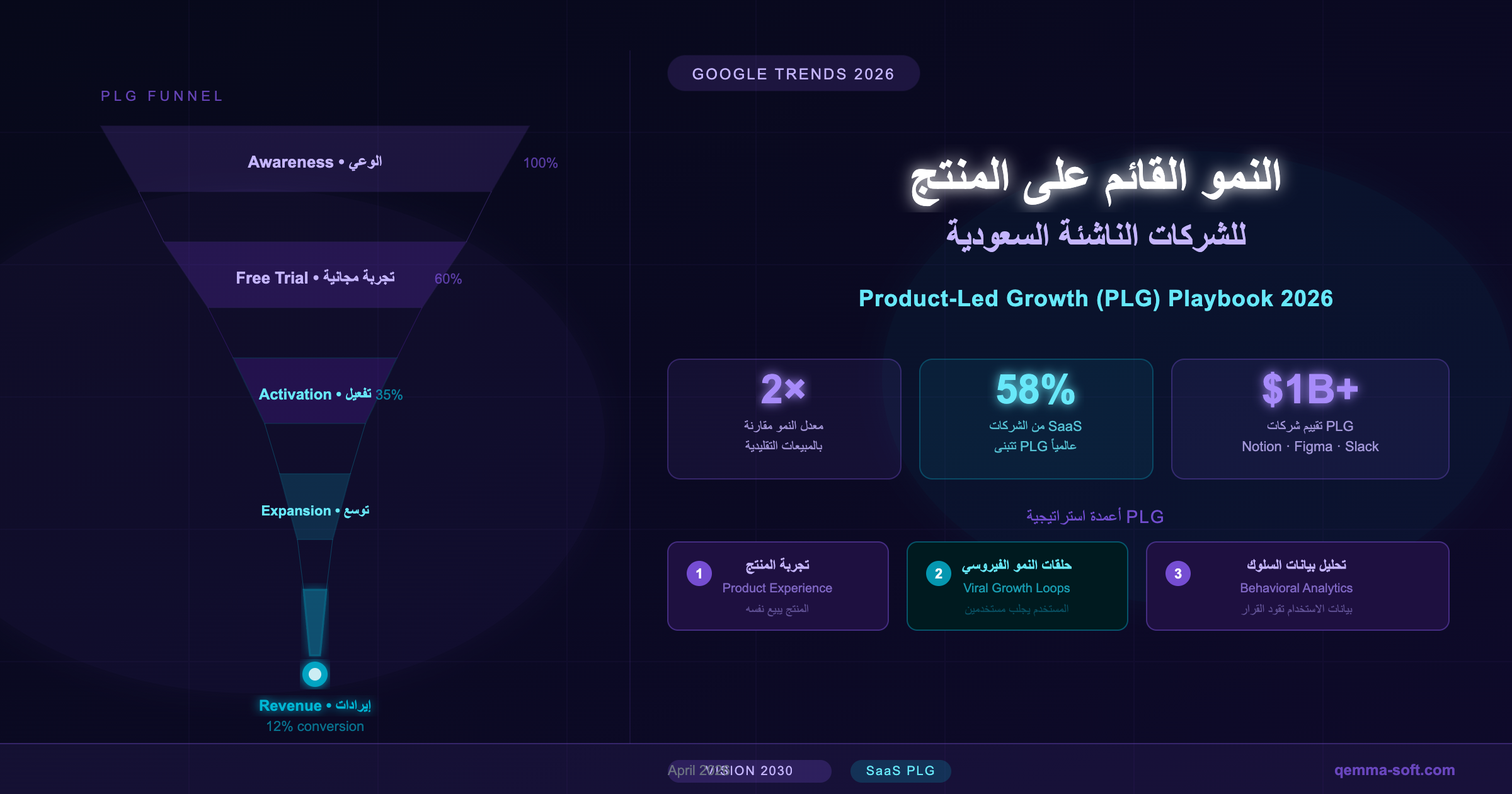
- 2× faster ARR growth compared to sales-led companies of similar size
- Lower Customer Acquisition Cost (CAC) — because the product markets itself through free trials, freemium, and word-of-mouth
- Higher Net Revenue Retention (NRR) — users who adopt the product bottom-up tend to expand organically as their teams grow
- 58% of global SaaS companies have now adopted some form of PLG in their go-to-market strategy
Simultaneously, B2B buyers have changed. Decision-makers in 2026 — including in Saudi Arabia — expect to try before they buy. They do their own research, run internal pilots, and bring the product to their procurement team after they are already convinced. A sales rep calling a cold lead is becoming increasingly ineffective.
The PLG Funnel: From Awareness to Expansion
Unlike a traditional sales funnel, the PLG funnel is product-centric at every stage:
1. Awareness — الوعي
Users discover your product through organic search, word of mouth, content marketing, or community. The product itself — through integrations, public templates, shareable outputs — becomes a distribution channel. When a designer shares a Figma file, they are involuntarily marketing Figma to every collaborator who opens the link.
2. Free Trial or Freemium — التجربة المجانية
PLG companies lower the barrier to entry to zero or near-zero. A free plan, a 14-day trial, or a sandbox environment lets users experience real value without procurement friction. The goal is speed-to-value: get the user to their "aha moment" in under 5 minutes.
3. Activation — التفعيل
Activation is the moment a user first experiences the core value of your product. In Notion, it might be creating their first linked database. In Slack, it might be sending a message to a team and getting an instant reply. Optimizing activation — through onboarding flows, tooltips, and progress indicators — is the highest-leverage activity in PLG.
4. Viral Growth Loops — حلقات النمو الفيروسي
The most powerful PLG products have built-in virality. Collaboration features (invite a teammate), network effects (value increases with more users), and shareable outputs (export a report, share a board) create loops where every new user generates potential new users. This is growth that compounds without proportional marketing spend.
5. Expansion — التوسع
PLG monetization often follows a land-and-expand model. A single user signs up for free. Their team adopts the product. The team grows, and they need more seats, more storage, or enterprise features. Revenue expands automatically as usage expands — without a renewal call from a sales rep.
PLG in the Saudi Startup Context
Saudi Arabia presents unique and compelling conditions for PLG adoption:
A Mobile-First, Digital-Native Market
Saudi Arabia has one of the highest smartphone penetration rates in the world. Saudi users are already accustomed to downloading apps, exploring free tiers, and making purchase decisions based on product experience rather than sales conversations. This is a PLG-ready audience.
Vision 2030 and the SaaS Ecosystem
Vision 2030 has catalyzed a surge in B2B SaaS adoption across Saudi enterprises. As SMEs digitize their operations through Monsha'at's support programs, and as large enterprises accelerate cloud adoption, there is a growing addressable market for PLG-first SaaS products built for the Saudi context — in Arabic, compliant with ZATCA e-invoicing (Fatoorah), and integrated with local payment rails.
Lower Sales Infrastructure Requirements
Building an enterprise sales team in Saudi Arabia is expensive and time-consuming. PLG allows Saudi startups to scale their user base without proportionally scaling their headcount — a critical advantage for early-stage founders with limited capital.
Core Pillars of a PLG Strategy
Pillar 1: Obsessive Product Experience Design
PLG lives and dies by onboarding. Your new user — whether they are a procurement manager in Riyadh or a small business owner in Jeddah — must experience tangible value within minutes of signing up. Map your user's journey meticulously. Identify friction points. Eliminate every unnecessary step between sign-up and the first "aha moment."
Pillar 2: Instrumented Behavioral Analytics
You cannot optimize what you do not measure. PLG requires deep product analytics: Which features drive activation? Where do users drop off? Which cohorts have the highest 30-day retention? Tools like Mixpanel, Amplitude, or PostHog — combined with custom event tracking in your Laravel or React application — give you the data to make product decisions based on real user behavior, not assumptions.
Pillar 3: Freemium or Free Trial Architecture
Carefully design your pricing tiers. The free tier must deliver genuine value — enough that users become habituated and dependent on your product. But it must have a natural ceiling that makes upgrading to paid feel like an obvious next step, not a forced paywall. The classic mistake is a free tier that is either too restrictive (users never experience value) or too generous (users never have a reason to upgrade).
Pillar 4: Built-In Virality Mechanics
Ask yourself: is there a natural moment in my product's use where a user would invite someone else, share an output, or publicly showcase the product? Build those moments intentionally. Add collaboration features. Include "Made with [Your Product]" branding on exported files. Create public galleries of user-generated content. Make sharing feel valuable to the user, not just to you.
PLG vs. Sales-Led: Which Is Right for Your Saudi Startup?
PLG is not a universal solution. It works best when:
- Your product can deliver value to an individual user without requiring organization-wide buy-in
- Your product has a natural collaborative or network component
- Your target customer can evaluate and adopt your product without a lengthy procurement process
- Your product is intuitive enough to be self-served
If you are selling a complex enterprise platform that requires deep customization and executive sign-off, a hybrid PLG + enterprise sales model (like Salesforce or SAP) may be more appropriate. Many successful SaaS companies — including Figma and Notion — use PLG for the bottom of the market while maintaining a sales team for large enterprise accounts.
Implementing PLG in Your Startup: A 6-Step Framework
- Define your "aha moment" — the single interaction where users first perceive the core value of your product
- Design onboarding for speed-to-value — reduce sign-up friction, eliminate unnecessary fields, use progressive disclosure
- Build your activation metrics — define what "activated" means and track it religiously in your analytics dashboard
- Identify your virality vectors — collaboration, sharing, integrations, public profiles, or referral programs
- Instrument your product — implement event tracking on every meaningful user action
- Run weekly PLG reviews — treat activation rate, time-to-value, and viral coefficient as your north star metrics
At Qemma Soft, we specialize in building PLG-ready products for the Saudi market — from instrumented React/Laravel applications to growth-optimized onboarding flows and viral sharing mechanics. Talk to our team to discuss how PLG can transform your startup's growth trajectory.