
Saudi Arabia has one of the fastest-growing e-commerce markets in the Middle East. With over 33 million internet users, a smartphone penetration rate above 95%, and a government actively investing in digital infrastructure through Vision 2030, the conditions for e-commerce success have never been better.
But building a successful online store requires more than just uploading products. It requires the right platform, a frictionless checkout experience, Saudi-specific payment integrations, regulatory compliance, and a performance-optimized setup that ranks on Google. This guide walks you through every critical step.
Why E-Commerce Is a Golden Opportunity in Saudi Arabia
- Market size: Saudi e-commerce exceeded SAR 50 billion in 2025, with double-digit annual growth projected through 2028.
- Mobile-first buyers: Over 78% of Saudi online purchases happen on mobile devices — making mobile optimization non-negotiable.
- Underserved niches: Many product categories still lack strong local online players, creating opportunities for new entrants.
- Logistics infrastructure: Saudi Post, Aramex, SMSA, and Naqel provide nationwide delivery coverage, removing a historic barrier to e-commerce.
- Local payment preference: Saudi buyers strongly prefer local payment methods — Mada, STC Pay, Apple Pay, Tabby, and Tamara — over international credit cards.
The 5 Essential Steps to Build a Successful E-Commerce Store
1. Choose the Right Platform: Custom vs. Ready-Made
This is the most important decision you will make. It affects cost, flexibility, performance, and your long-term ability to grow.
Ready-made platforms (Salla, Zid, Shopify): Fast to launch (days, not months), lower upfront cost, built-in Arabic RTL support for Saudi platforms. Best for: small stores with standard product catalogues, businesses testing the market before committing to a custom build.
Custom development (Laravel, Next.js): Full control over design, features, and integrations. No monthly platform fees. Better performance and SEO. Required for: complex business logic (subscriptions, multi-vendor, B2B pricing), large catalogues, unique customer experiences, and businesses that need deep integration with existing ERP or CRM systems.
The decision rule: if you can describe your store as "standard," start with a ready-made platform. If you have specific requirements that ready-made platforms cannot handle, invest in custom development from the start — retrofitting custom features onto a rigid platform is expensive.
2. Design a Professional Arabic UX
A Saudi e-commerce store must be designed natively in Arabic RTL — not just translated. The difference is significant: proper RTL means the entire layout mirrors, icons face the correct direction, navigation flows right to left, and Arabic typography is selected for maximum readability.
Key UX principles for Saudi e-commerce:
- Large, high-quality product images (Saudi buyers examine details closely before purchasing)
- Clear price display in Saudi Riyals with VAT included
- Prominent delivery time and free shipping thresholds
- Trust signals: reviews, return policy, secure payment badges
- Simple 3-step checkout maximum — every additional step loses 20% of potential buyers
3. Integrate Saudi Payment Gateways
This is where many international e-commerce solutions fail Saudi stores. Local payment methods are not optional — they are the primary way Saudi consumers prefer to pay:
- Mada: Saudi Arabia's national debit network — the most widely used payment method in the Kingdom
- STC Pay: Saudi Telecom's digital wallet — huge adoption especially among younger demographics
- Apple Pay / Google Pay: Widely used for mobile purchases
- Tabby & Tamara: Buy Now Pay Later solutions with very high conversion impact — studies show BNPL options increase average order value by 25–40%
Recommended Saudi payment gateways: HyperPay, MyFatoorah, PayTabs — all support the above methods and integrate cleanly with custom-built stores.
4. ZATCA E-Invoicing Compliance
Since 2022, Saudi businesses above a certain revenue threshold are required to issue e-invoices compliant with ZATCA's standards. For e-commerce stores processing commercial transactions, this means:
- Every order generates a ZATCA-compliant e-invoice with the required fields (QR code, seller TIN, VAT amount)
- Integration with ZATCA's FATOORAH system for Phase 2 compliance (mandatory for larger businesses)
- Proper VAT calculation (15%) displayed and charged at checkout
Building ZATCA compliance into your store from day one is significantly cheaper than retrofitting it later.
5. Speed, Performance, and SEO
Google's Core Web Vitals are direct ranking factors. A slow store loses both Google rankings and customers. For Saudi e-commerce specifically:
- Target under 2.5 seconds for Largest Contentful Paint on mobile
- Use a CDN with Middle East edge locations (Cloudflare, AWS CloudFront with Bahrain/UAE regions)
- Compress and lazy-load all product images
- Arabic product pages with proper title tags, meta descriptions, and structured data (Product schema)
- Arabic keyword research focused on how Saudi buyers actually search (dialect variations matter)
E-Commerce Development Cost in Saudi Arabia 2026
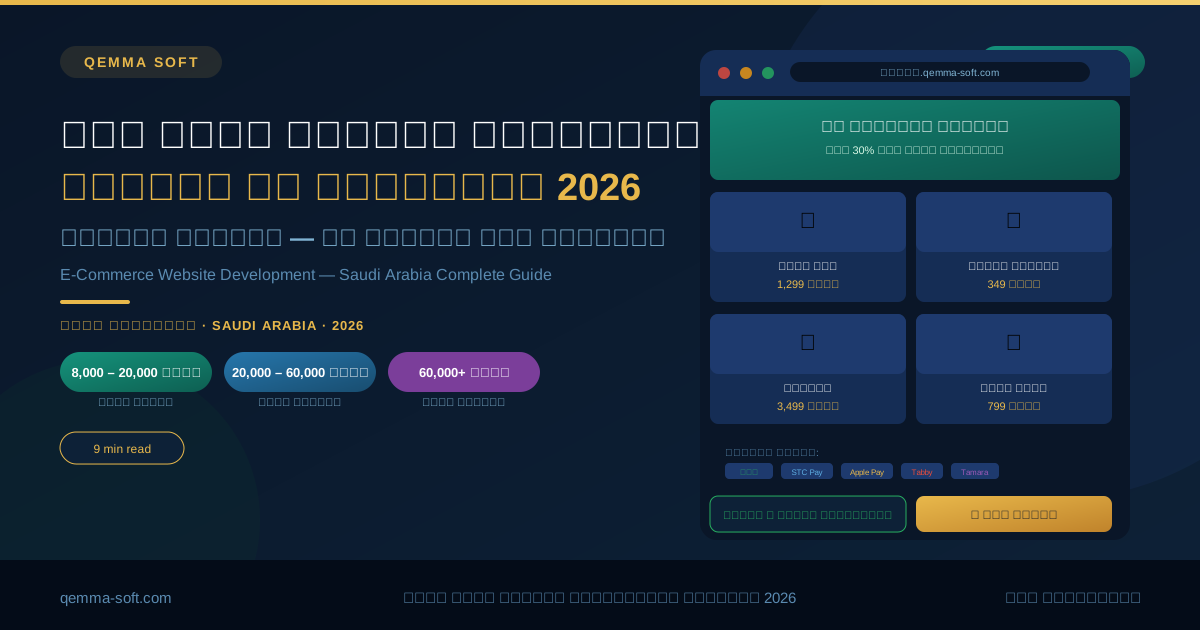
Basic Store — SAR 8,000 to 20,000
Up to 500 products, standard design, Mada + STC Pay integration, basic admin panel, mobile-responsive. Best for: small retailers entering e-commerce for the first time.
Full-Featured Store — SAR 20,000 to 60,000
Unlimited products, custom design, all Saudi payment gateways, ZATCA compliance, order management, inventory alerts, customer accounts, discount/coupon system, Google Analytics, full SEO setup. Best for: established businesses building a serious online sales channel.
Advanced Platform — SAR 60,000 and above
Multi-vendor marketplace, subscription models, B2B pricing tiers, ERP/CRM integration, custom logistics integration, advanced analytics dashboard, mobile app companion. Best for: large retailers, marketplace concepts, and businesses with complex operational requirements.
Ready-Made Platform vs. Custom Store — Which Is Right for You?
Use a ready-made platform (Salla, Zid) if: you have a standard product catalogue, you want to launch quickly, and your budget is under SAR 5,000.
Invest in custom development if: you need specific features not available on ready-made platforms, you have a large or complex catalogue, you need deep integration with existing business systems, or you want full control over design and performance without paying monthly platform fees that scale with revenue.
How Qemma Soft Builds Your E-Commerce Store
At Qemma Soft, we build custom e-commerce stores designed specifically for the Saudi market:
- Full Arabic RTL design — natively built, not translated
- All Saudi payment gateways: Mada, STC Pay, Apple Pay, Tabby, Tamara
- ZATCA e-invoicing compliance built in
- Performance-optimized for Saudi mobile buyers
- SEO setup from day one — Arabic keyword strategy included
- Admin panel you can operate without a developer
Read our related guides: best website design company for small businesses and how to choose the right software company.
Request a Free E-Commerce Development Quote →
Frequently Asked Questions
Can I start with Salla or Zid and migrate to a custom store later?
Yes, but migration has costs. Product data, customer accounts, and order history can be exported, but the design and custom features must be rebuilt. If you expect to outgrow a ready-made platform within 12–18 months, it is often more efficient to build custom from the start.
Do I need ZATCA compliance for my e-commerce store?
If your business is VAT-registered in Saudi Arabia and you are processing commercial sales, ZATCA e-invoicing compliance is legally required. Phase 1 (generation of e-invoices) applies to all VAT-registered businesses. Phase 2 (integration with ZATCA's FATOORAH) is being rolled out in waves based on annual revenue thresholds.
How long does it take to build a custom e-commerce store?
A basic custom store takes 6–10 weeks. A full-featured store takes 10–16 weeks. Timeline depends on the number of products, complexity of the admin panel, payment gateway approvals (allow 1–2 weeks for payment gateway onboarding), and how quickly design concepts are approved.
What is the best payment gateway for Saudi e-commerce?
HyperPay and MyFatoorah are the most widely used for custom Saudi stores — both support Mada, STC Pay, Apple Pay, Tabby, and Tamara in a single integration. PayTabs is another reliable option, particularly for businesses with international transactions.