
Your business is a target. Not because of who you are — but because you are online.
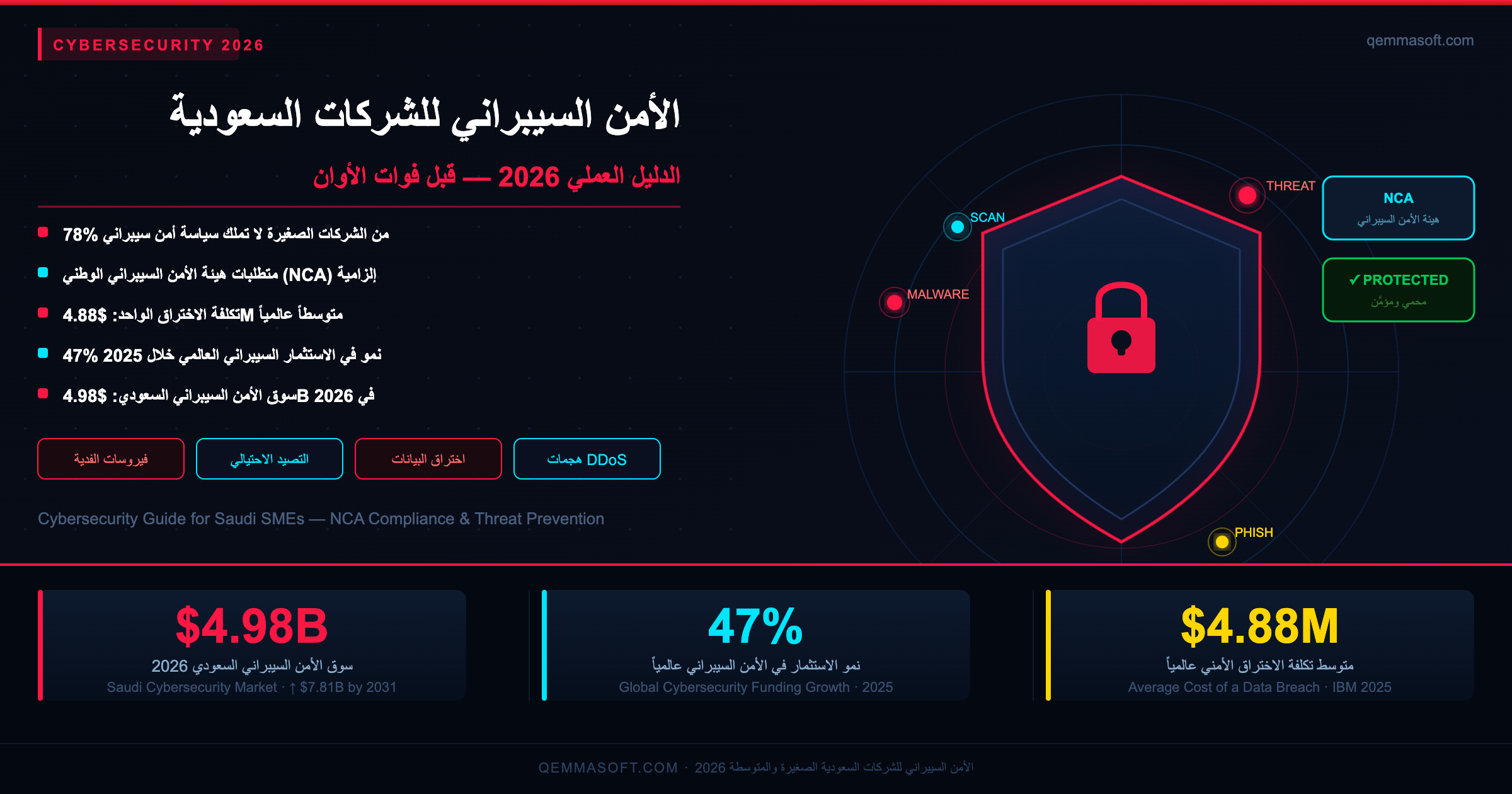
In 2026, Saudi Arabia's cybersecurity market has grown to $4.98 billion and is on track to reach $7.81 billion by 2031. This growth is not driven by large enterprises alone — it is driven by the painful reality that small and medium businesses are now the primary target of cybercriminals worldwide, precisely because they have the least protection.
The Saudi SME Cybersecurity Gap
A 2025 study of SMEs across the GCC revealed that:
- 78% of small and medium businesses have no documented cybersecurity policy
- 61% have never conducted a security audit or vulnerability assessment
- 43% use the same password across multiple business systems
- Only 12% have a formal incident response plan — meaning 88% have no idea what to do when (not if) a breach occurs
Meanwhile, the National Cybersecurity Authority (NCA) of Saudi Arabia has been progressively expanding its mandatory compliance framework beyond large enterprises. In 2026, NCA's Essential Cybersecurity Controls (ECC) and Cloud Cybersecurity Controls (CCC) apply to an increasingly wide range of private sector entities, with penalties for non-compliance escalating annually.
The Top 5 Threats Hitting Saudi Businesses Right Now
1. Ransomware (فيروسات الفدية) Ransomware attacks encrypt your entire business data and demand payment — typically in cryptocurrency — for the decryption key. Saudi businesses experienced a 68% increase in ransomware attempts in 2025. The average ransom demand in the GCC region is now $285,000 — but the total cost including downtime, recovery, and reputational damage averages $1.85 million per incident.
What makes Saudi businesses vulnerable: Many SMEs run outdated Windows systems without automatic updates, and rely on local backups stored on the same network as the primary data — meaning a ransomware attack encrypts both simultaneously.
2. Phishing and Business Email Compromise (BEC) A phishing email impersonates a trusted entity — your bank, a government authority, a supplier, or even your CEO — to trick an employee into revealing credentials, transferring money, or installing malware. In Saudi Arabia, phishing attacks increased 54% in 2025, with Arabic-language phishing messages now common.
Business Email Compromise (BEC) is the most financially costly variant: an attacker compromises a business email account and uses it to redirect legitimate payments. The FBI reported global BEC losses of $2.9 billion in 2025.
3. Supply Chain Attacks If you use third-party software, SaaS tools, or external developers, you inherit their security vulnerabilities. The 2025 SolarWinds follow-on attacks and several Saudi-specific supply chain incidents affected hundreds of businesses that had never been directly targeted. Your security is only as strong as your weakest vendor.
4. Insider Threats Whether malicious or accidental, employees remain one of the top causes of data breaches. A disgruntled employee exporting your customer database, or an unwitting staff member clicking a phishing link — both create the same outcome: your business data is compromised.
5. Credential Stuffing and Account Takeover Billions of username-password combinations are available on the dark web from previous data breaches. Automated bots test these credentials against Saudi business platforms, banking portals, and e-commerce backends. If any employee reuses a password from a previously breached service, your systems are exposed.
NCA Compliance: What Saudi Businesses Must Know
The National Cybersecurity Authority (هيئة الأمن السيبراني الوطني) has established several mandatory frameworks. Understanding which apply to your business is the first step:
Essential Cybersecurity Controls (ECC-1:2018, updated 2022) The ECC covers five domains: Cybersecurity Governance, Risk Management, Cybersecurity Resilience, Third-Party Cybersecurity, and Industrial Control Systems Security. All government entities and critical infrastructure operators must comply. In 2026, NCA has expanded voluntary compliance guidance to private sector SMEs.
Cloud Cybersecurity Controls (CCC-1:2020) If your business uses cloud services — including hosted email, cloud storage, SaaS applications, or cloud-based ERP — the CCC framework applies. Any data classified as "sensitive" under Saudi regulations (personal data, financial records, health information) must be processed according to CCC requirements.
Personal Data Protection Law (PDPL) Saudi Arabia's PDPL — effective September 2023 — is the Kingdom's equivalent of GDPR. It requires organizations that collect, process, or store personal data of Saudi residents to implement specific technical and organizational security measures, obtain explicit consent, notify authorities of breaches within 72 hours, and appoint a data protection officer for companies processing data at scale.
Non-compliance penalties: fines up to SAR 5 million (approximately $1.33 million) for serious violations.
The 6-Step Cybersecurity Protection Framework for Saudi SMEs
You do not need a million-dollar budget. You need a structured approach:
Step 1: Asset Inventory — Know What You Have You cannot protect what you do not know exists. List every device, software, and data store connected to your business network. Include employee phones that access work email, cloud services, and third-party integrations.
Step 2: Access Control — Limit Who Can See What Implement the principle of least privilege: every employee should have access only to the systems and data they specifically need for their role. Use role-based access control (RBAC). This single step eliminates the majority of insider threat and compromised account risks.
Step 3: Multi-Factor Authentication (MFA) — Everywhere MFA adds a second verification step beyond passwords. Even if an attacker steals an employee's password, they cannot access your systems without the second factor (a code sent to a phone, or a hardware token). Enable MFA on: business email, accounting software, cloud storage, admin panels, and VPN access.
Step 4: Backup and Recovery — The 3-2-1 Rule Keep 3 copies of your data, on 2 different types of storage media, with 1 copy stored offsite (cloud backup is ideal). Test your backup restoration process quarterly — many businesses discover their backups are corrupted only when they desperately need them after a ransomware attack.
Step 5: Employee Security Training 97% of cyberattacks require a human action — clicking a link, opening an attachment, providing credentials. Run monthly phishing simulation exercises. Train employees to recognize social engineering. Establish a clear protocol for reporting suspicious emails or system behavior without fear of blame.
Step 6: Incident Response Plan Document what happens when a breach occurs: Who is notified first? Who contacts NCA if required? Who communicates with customers? Who handles media inquiries? A written incident response plan reduces your average breach recovery time by 55% and significantly reduces financial losses.
Cybersecurity Tools Every Saudi SME Should Deploy
Essential (Free or Low Cost):
- Microsoft Defender or CrowdStrike Falcon Go — Endpoint protection for all devices
- Cloudflare — Free DNS-level protection against DDoS and malicious websites
- Bitwarden or 1Password — Business password manager (eliminates password reuse)
- Google Workspace / Microsoft 365 — Built-in email security, MFA, and audit logging
Intermediate (Paid but affordable):
- Darktrace Essentials — AI-powered network monitoring that detects anomalous behavior
- Veeam Backup — Automated, tested backup for on-premise and cloud data
- KnowBe4 — Employee security awareness training and phishing simulations
The Cost of Doing Nothing
The average Saudi SME spends less than SAR 5,000 ($1,330) per year on cybersecurity. The average cost of a single data breach in the Middle East region is $8.75 million — the highest globally, according to IBM's 2025 Cost of a Data Breach Report.
This is not a risk calculation. This is a business continuity question. One successful ransomware attack can permanently close a small business that does not have offline backups and the capital to recover.
What Qemma Soft Can Do For Your Business
At Qemma Soft, every web application and mobile application we build is developed with security-first principles: encrypted data transmission (HTTPS/TLS 1.3), parameterized database queries to prevent SQL injection, input validation and sanitization, secure authentication with MFA support, and regular dependency auditing.
We also help clients implement technical security controls as part of our software development and digital transformation services — ensuring your digital systems are not just functional, but defensible.