Whether you own a restaurant, a retail store, a clinic, or a fast-growing startup — one of the first questions you'll ask when considering a mobile app is: how much will it cost? In Saudi Arabia, the answer depends on many factors that we'll break down clearly in this guide.
Understanding app development costs before you start protects your budget, helps you evaluate vendor proposals accurately, and prevents the most common mistake Saudi business owners make: choosing the cheapest option and ending up with an unusable product.
Why Mobile Apps Matter for Saudi Businesses in 2026
Saudi Arabia has one of the highest smartphone penetration rates in the world — over 95% of the population owns a smartphone. Consumers expect to interact with brands through apps. A well-built mobile app can:
- Increase repeat purchases through loyalty programs and push notifications
- Reduce customer service load with self-service features
- Collect valuable customer data for marketing decisions
- Improve brand perception and customer trust
- Enable direct sales through Mada, STC Pay, Apple Pay, Tabby, and Tamara
The question is not whether to build an app, but how to build it right within your budget.
The 6 Key Factors That Determine App Development Cost
1. Platform: iOS, Android, or Both?
Building for both iOS and Android using a cross-platform framework like Flutter costs roughly 30–40% more than a single platform — but reaches 100% of the Saudi market. Building native apps separately (Swift for iOS, Kotlin for Android) costs nearly double and is only justified for apps with very high performance requirements.
Recommendation: For most Saudi business apps, Flutter (cross-platform) is the optimal choice — one codebase, both platforms, lower cost.
2. App Type and Complexity
The category of your app directly impacts development time and cost:
- E-commerce app: Product catalogue, cart, checkout, order tracking, payment gateways
- Service booking app: Calendar, scheduling, notifications, provider/customer matching
- SaaS app: Multi-user dashboards, subscription billing, complex business logic
- Educational app: Content management, video streaming, progress tracking, quizzes
- Entertainment app: Media delivery, social features, real-time interactions
3. UI/UX Design: Custom vs. Template
A fully custom design with unique brand identity, micro-animations, and pixel-perfect Arabic RTL layout costs significantly more than a template-based approach — but converts better and differentiates your brand in a competitive market. Template-based designs save cost but look generic.
4. Technical Complexity
Each additional technical layer adds development time:
- User authentication and roles (customer, admin, delivery driver)
- Real-time features (live chat, order tracking on map)
- Third-party API integrations (ZATCA, payment gateways, shipping companies)
- Admin dashboard and analytics panel
- Multi-language support (Arabic RTL + English)
- Offline mode and data synchronization
5. Saudi Market-Specific Requirements
Apps targeting the Saudi market have specific technical requirements not every development company handles well:
- Full Arabic RTL interface (not just translation — complete right-to-left layout)
- Saudi payment gateway integrations: Mada, STC Pay, Apple Pay, Tabby, Tamara
- ZATCA e-invoicing compliance for commercial transactions
- Arabic push notifications
- Saudi phone number formats (+966)
6. Ongoing Maintenance and Support
App development doesn't end at launch. Budget for ongoing costs: OS updates (iOS and Android release major updates annually), bug fixes, new features, and server hosting. Plan for 15–20% of the initial development cost per year for maintenance.
Average App Development Costs in Saudi Arabia (2026)
Based on current market rates for Saudi-focused development:
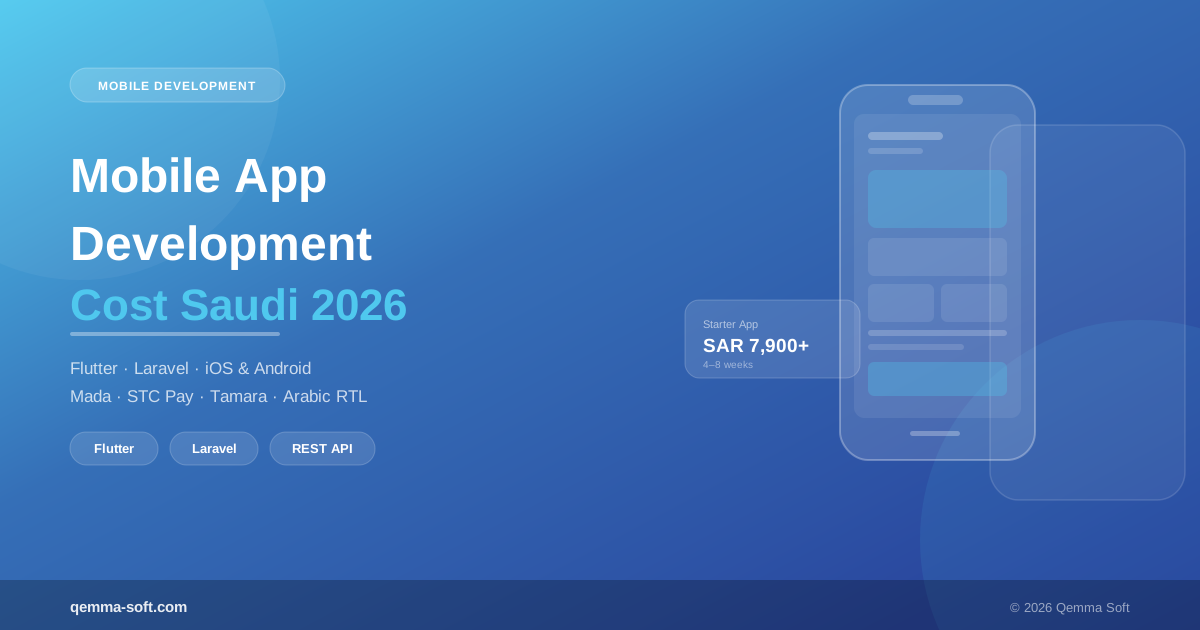
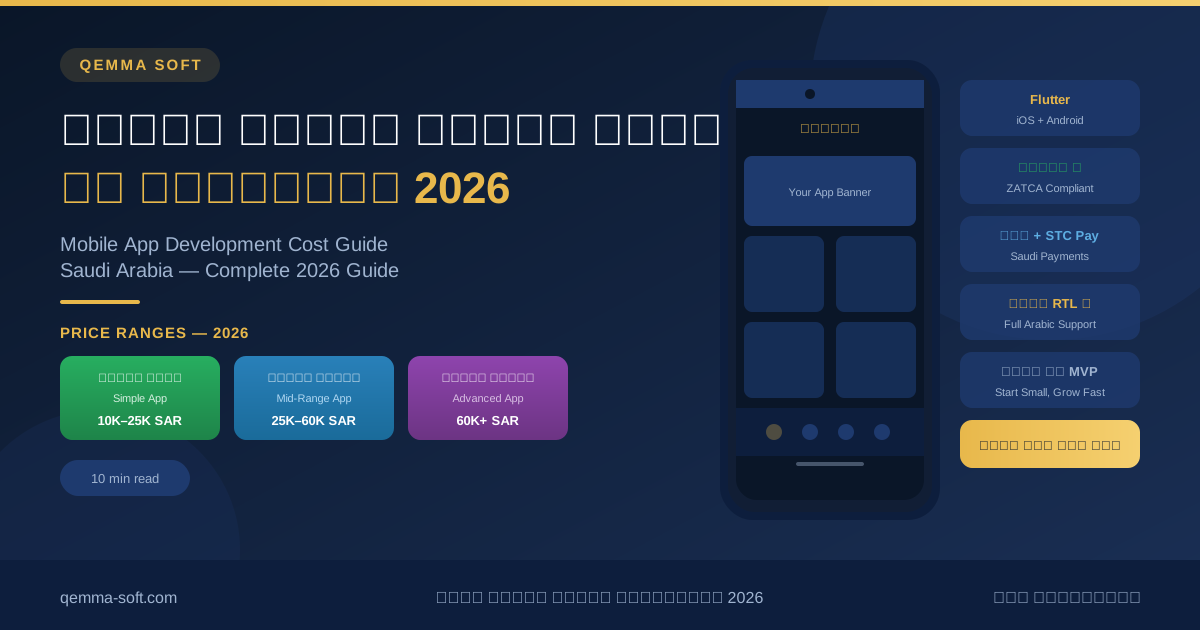
Simple App — SAR 10,000 to 25,000
What you get: 5–10 screens, basic functionality, template-based design, single platform (iOS or Android), no third-party integrations.
Examples: business card app, simple booking form, basic product catalogue with WhatsApp contact.
Mid-Range App — SAR 25,000 to 60,000
What you get: 10–25 screens, custom design, both iOS and Android (Flutter), 1–2 payment gateway integrations, admin panel, Arabic RTL fully supported, push notifications.
Examples: restaurant ordering app, service booking app, small e-commerce app, clinic appointment system.
Advanced App — SAR 60,000 and above
What you get: 25+ screens, fully custom design and branding, complex business logic, multiple integrations (payments, shipping, ZATCA, SMS, maps), multi-role system, real-time features, dedicated admin dashboard with analytics.
Examples: full e-commerce platform, SaaS product, ride-hailing or delivery app, enterprise management system.
Note: These are indicative price ranges. Final cost depends on the specific company, team seniority, project timeline, and level of quality.
5 Practical Tips to Reduce App Development Cost
1. Start with an MVP (Minimum Viable Product)
Build only the core features needed to launch and validate your idea. An MVP typically costs 40–60% less than the full product. Once you have real users and feedback, invest in additional features with confidence.
2. Use Cross-Platform Development (Flutter)
Flutter lets one team build for both iOS and Android simultaneously. Compared to two separate native apps, you save 30–40% in development cost.
3. Prepare Detailed Requirements Before Requesting Quotes
Vague requirements lead to vague proposals and surprise costs later. Write down exactly what screens you need, what each screen does, and what integrations are required. This alone can save 20% in scoping and revision time.
4. Choose a Template Design for Non-Customer-Facing Screens
Reserve custom design budget for screens customers see (home, product, checkout). Admin and back-office screens can use standard UI components without impacting the customer experience.
5. Sign a Fixed-Price Contract with Clear Scope
Time-and-materials contracts can spiral in cost. A fixed-price contract with a clearly defined scope protects your budget — as long as the scope is documented thoroughly before signing.
How to Choose the Right Mobile App Development Company in Saudi Arabia
Check Their Saudi Market Portfolio
Look for apps they've built for Saudi clients specifically. Have they integrated Mada? Built Arabic RTL interfaces? Handled ZATCA requirements? Ask to see live apps in the Saudi App Store or Google Play.
Verify Technical Expertise
Ask which framework they use and why. A company recommending Flutter for a standard business app is making a sound technical decision. A company insisting on building two separate native apps for a basic use case may be inflating the budget unnecessarily.
Evaluate Support and Maintenance Commitment
The relationship doesn't end at app launch. Ask specifically: What is your support process after delivery? What is your guaranteed response time for critical bugs? Do you support in Arabic during Saudi business hours?
Ask for a Direct Client Reference
A professional company will connect you with a past Saudi client who can speak honestly about the experience. This single step filters out 80% of unreliable vendors.
Conclusion: What Should Your App Budget Be?
For most Saudi SMEs and startups, a well-built mid-range app (SAR 25,000–60,000) delivers the best return on investment. It's enough to build a professional, fully functional product with Saudi payment integrations, Arabic RTL support, and a basic admin panel — without overspending on features you don't need yet.
Start with a clear scope, choose a company with proven Saudi market experience, and build an MVP before committing to the full feature set.
At Qemma Soft, we specialize in mobile app development for the Saudi market — Flutter apps with full Arabic RTL support, Mada and STC Pay integration, and ZATCA compliance.